Принципы работы Next Hop Resolution Protocol
Speed up traffic and cut hub load with NHRP: you learn spoke-to-spoke path discovery, configuration commands, and troubleshooting in non-broadcast networks.
Content of the article
The Next Hop Resolution Protocol (NHRP) is a network protocol designed to simplify routing in non-blocking networks. Its primary purpose is to allow network nodes to dynamically find the shortest paths to each other, bypassing intermediate routers such as a central hub. In today's high-traffic networks, NHRP plays a key role in traffic optimization, making it an important tool in the arsenal of network administrators. This article will cover the basic principles of NHRP, the commands used to configure it, and how to use it to troubleshoot network problems.
What is NHRP and its main purposes?
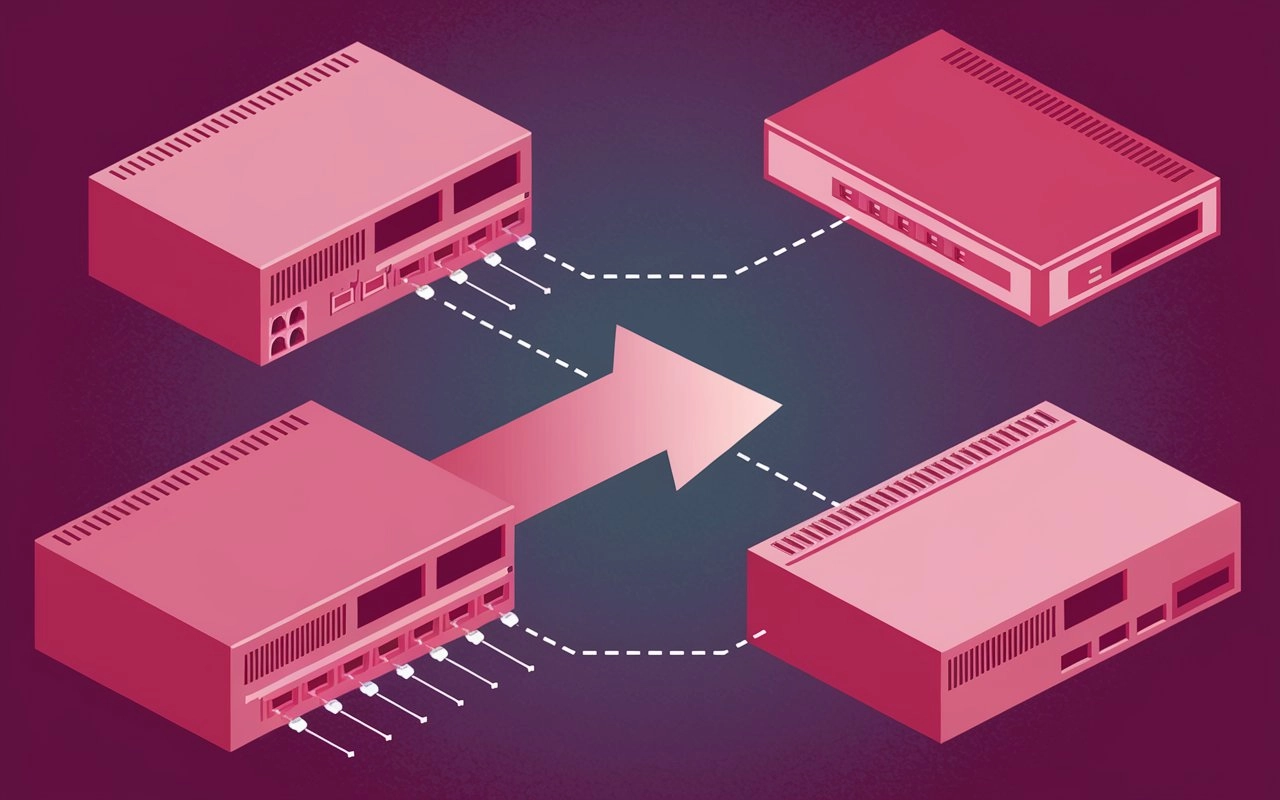
NHRP was originally designed for use in networks such as Frame Relay and ATM, which do not support Layer 2 broadcasting. In such networks, routers, called spoke routers, cannot directly communicate with each other and are forced to forward traffic through a central router (hub). This creates serious performance issues, especially with a large number of nodes. NHRP solves this problem by allowing routers to find and use direct routes to each other, which significantly reduces the load on the central hub and speeds up data transfer.
The main principles of NHRP:
- Registration and discovery. In networks that support NHRP, routers (spokes) register their public IP-addresses with the central NHRP server (hub). Once registration is complete, spokes can discover other spokes on the same network and use their IP addresses for direct communication.
- Moving from a centralized architecture to a decentralized one. Networks without NHRP can be compared to an old-style telephone system, where every call goes through an operator panel, which slows down communication as the load increases. NHRP works like a mobile phone system, where devices can communicate directly by knowing each other's IP addresses.
- Reduce the load on the hub. Using NHRP allows clients and servers on the network to communicate directly, bypassing the central hub, which reduces latency and improves network performance. It also increases network flexibility, allowing new nodes to be easily added without the need for complex route configuration.
NHRP uses a set of commands to configure and manage the interactions between nodes on the network. Some of the key commands are:
- IP NHRP NETWORK-ID (NUMBER). Enables NHRP on an interface (usually a tunnel). All devices connected to the same network must use the same network ID to recognize each other.
- IP NHRP NHS (NEXT HOP SERVER IP). Specifies the IP address of one or more NHRP servers with which spokes should communicate to register their IP addresses. This command is enabled in interface configuration mode.
- IP NHRP MAP (NHS IP ADDRESS) (PHYSICAL IP ADDRESS OF HUB). Statically maps an NHRP IP address to the physical IP address of the hub. This command is used to register nodes and to allow routers to find other devices on the network.
- IP NHRP MAP MULTICAST. Allows multicast packets to be sent over a tunnel network, which is useful when the physical network does not support multicast.
- IP NHRP HOLDTIME (SECONDS). Changes the retention time for dynamic entries in the NHRP cache. By default, entries are retained for 7200 seconds (two hours). However, to avoid unnecessary delays, it is recommended to reduce this value to 600 seconds.
- IP NHRP REGISTRATION TIMEOUT (SECONDS). Configures the frequency of sending registration messages. By default, this setting is set to one third of the record storage time (for example, 40 minutes), but it is recommended to reduce the value to 30 seconds to speed up the registration processes.
Using NHRP helps to avoid the following problems in NBMA networks (Non-Broadcast Multiple Access is a type of network that does not support broadcast and multicast data transmissions):
- Routing bottlenecks. In traditional NBMA networks, all data must be transmitted through a central hub, which creates bottlenecks, especially with large traffic volumes. NHRP allows spokes to find and use the shortest routes to each other, bypassing the hub, which significantly reduces the load on the central router.
- Flexibility in network configuration. NHRP allows you to easily add new nodes to the network without the need for complex configuration of virtual channels or routes. This makes the network more adaptive to change, which is especially important for modern companies that often expand their network resources.
- Traffic optimization. Due to direct interaction between network nodes, the amount of traffic transmitted through the central hub is reduced. This increases the data transfer rate and reduces infrastructure maintenance costs.
An example of NHRP in a network
Let's imagine a network with a server S1 and two clients A2 and A3 connected through a provider. In a traditional network architecture, all traffic goes through the provider and the hub. However, using NHRP, clients can establish static tunnels with each other, and dynamic routing allows finding optimal data transmission paths. Clients A2 and A3 can exchange IP addresses and directly transmit data without the participation of the provider, which significantly speeds up the communication process.
Private VPN server and NHRP
A private VPN server can effectively use NHRP to optimize routing in its network. This solution will speed up data transfer between devices, bypassing the central server of the provider, which is especially important for users who need high-speed access to resources and data protection.
Private VPN server has collected many reasons why it is worth buying a private VPN server. In addition, the resource provides complete information on the terms of such a purchase: the text of the public offer, prices and terms of use of the service, as well as a FAQ section and articles about VPN.