Hub-and-Spoke vs Full Mesh: Designing Corporate VPNs for 5, 20, and 100 Branches
The complete guide to choosing and designing corporate VPN topologies: Hub-and-Spoke and Full Mesh for 5, 20, and 100 branches. Practical advice, checklists, protocols, high availability, security, cost efficiency, monitoring, and real enterprise-level case studies.
Content of the article
- Introduction: why compare hub-and-spoke and full mesh in 2026
- Basics: core concepts and terminology
- Deep dive: from architectural patterns to risk management
- Practice 1: choosing topology by scale — 5, 20, and 100 branches
- Practice 2: step-by-step hub-and-spoke design
- Practice 3: designing full mesh and partial mesh
- Practice 4: cost, capacity planning, and operations
- Practice 5: security, compliance, and zero trust
- Practice 6: cloud hubs, sase, and hybrid models
- Practice 7: pilots, poc, and quick start
- Common mistakes: what to avoid
- Tools and resources: what to use
- Case studies and outcomes: implementation examples
- Faq: tough questions with detailed answers
- Conclusion: strategic framework and next steps
Introduction: Why Compare Hub-and-Spoke and Full Mesh in 2026
Digital workflows are expanding, and distributed teams with branch offices are becoming the norm. At the same time, requirements for secure channels, observability, and recovery times are getting stricter. Connecting a branch to headquarters has become easier, but ensuring predictable performance, manageability, and scalability across dozens of sites is more challenging. In this article, we'll systematically explore when a Hub-and-Spoke VPN topology makes sense and when Full Mesh or a hybrid partial mesh is a better fit. We'll start with core principles, dive into deep architecture, and then share practical methods for networks with 5, 20, and 100 branches. You'll find step-by-step instructions, checklists, standard configurations, key metrics, and real-world cases. The goal is simple: provide you with a solid decision-making framework to minimize project risks, investment, and deployment time.
Basics: Core Concepts and Terminology
Topologies
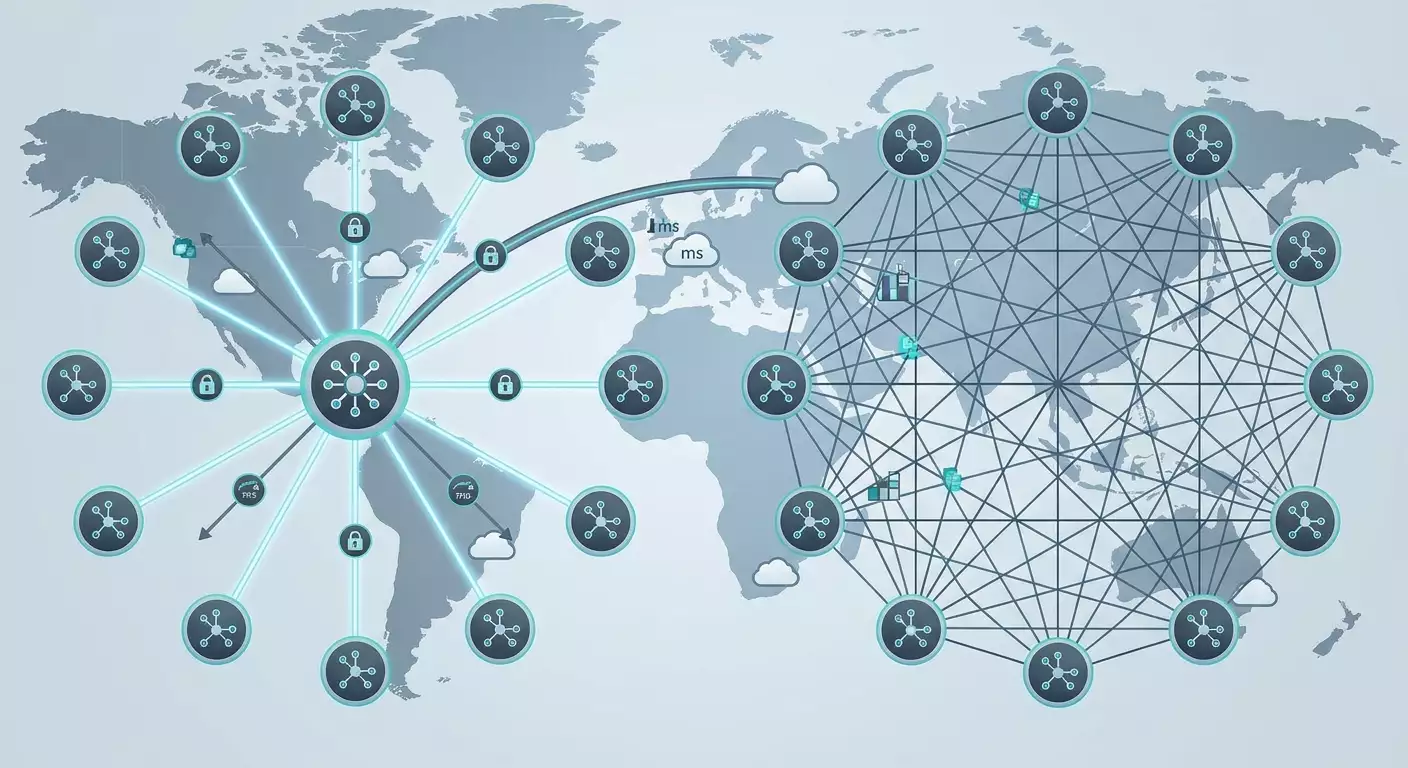
- Hub-and-Spoke: A central hub site with spokes for branches. All inter-branch communication routes through the hub. Benefits include simplicity, centralized control, and clear traffic engineering. Drawbacks include potential single points of failure and bottlenecks in bandwidth and latency.
- Full Mesh: Every site has a tunnel to every other. Pros are minimal latency between branches and high resilience. Cons are the quadratic growth of tunnels and policies, making management complex.
- Partial Mesh: A hybrid where critical nodes are connected directly, while others connect via hubs or regional aggregators.
Transport and Overlays
- Underlay: Internet, MPLS L3VPN, mobile links, LTE/5G, dedicated internet access (DIA), broadband. Underlay impacts latency, jitter, and packet loss.
- Overlay: Secure tunnels like IPsec, WireGuard, OpenVPN, IKEv2, SSTP, L2TP. This layer handles encryption, authentication, and routing.
Routing
- Static routing: Simple but doesn't scale well.
- OSPF: An IGP providing dynamic routing within an autonomous system, handy for large Hub-and-Spoke networks.
- BGP: Used for inter-domain scenarios, scaling very large networks and multi-hub setups, ideal for SD-WAN and overlay prefix internet routing.
Security
- Crypto profile: A set of algorithms and parameters such as IKEv2, AES-GCM, ChaCha20-Poly1305, PFS, key length, and SA rotation intervals.
- Authentication: X.509 certificates, EAP-TLS, pre-shared keys, and integration with corporate PKI.
- Segmentation: VRF, VLAN, policy-based routing, security groups to isolate critical segments.
Observability
- Telemetry: SNMP, NetFlow/IPFIX, sFlow, gNMI, export of tunnel metrics and logs.
- SLO/SLA: Measured metrics include latency, loss, jitter, availability, configuration time, and recovery time.
Deep Dive: From Architectural Patterns to Risk Management
When Hub-and-Spoke Makes Sense
If most applications reside in data centers or cloud hubs, and inter-branch traffic is light, Hub-and-Spoke offers predictable routing, simple segmentation, and controlled internet breakout points. It also facilitates DLP and traffic inspection. Risks include load concentration and hub dependency, which can be mitigated by scaling hubs, active-active clusters, splitting regional hubs, and proper QoS.
When Full Mesh is Justified
When East-West traffic between branches dominates, such as voice or branch-to-branch data replication, Full Mesh minimizes latency and eliminates hairpin routing through the hub. Challenges are manageability and scalability, which can be eased by automation, SD-WAN controllers, using BGP with route-reflector logic, and applying partial mesh for high-demand pairs.
Partial Mesh as a Compromise
Often, direct tunnels only between groups of branches with heavy mutual traffic are sufficient, while others connect via hubs. This brings 80% of Full Mesh benefits at 20% of its complexity.
2026 Trends
- Rise of WireGuard in branch scenarios thanks to its simplicity and CPU efficiency on general-purpose hardware.
- SD-WAN becoming the default for overlay automation, dynamic underlay selection, application-aware routing, and centralized policies.
- VPN and Zero Trust convergence: device authentication, posture checks, micro-segmentation.
- Broad adoption of cloud hubs and POPs, with regional concentrators closer to users.
- Infrastructure as code for networks: declarative manifests for topologies and policies.
Practice 1: Choosing Topology by Scale — 5, 20, and 100 Branches
Decision-Making Approach
- Assess dominant flows: branch-to-DC, branch-to-cloud, branch-to-branch.
- Measure network SLOs: 95th percentile RTT, jitter, loss, availability.
- Match application requirements: voice/video are latency-sensitive, ERP cares about loss, storage depends on jitter.
- Consider compliance: local laws, PCI DSS, ISO 27001, industry standards.
- Create a benefits/risks matrix for topologies and pick the minimally sufficient complexity.
Scenario: 5 Branches
- Recommendation: Hub-and-Spoke with a backup mini-hub or active-active pairs in different regions.
- Routing: OSPF or static with centralized propagation through the hub.
- Crypto: WireGuard or IKEv2/IPsec with PFS, AES-GCM or ChaCha20-Poly1305.
- QoS: 3-4 classes — voice, critical apps, bulk, best effort.
- SLA: Hub availability above 99.95%, branch-hub latency not exceeding 40-60 ms for voice.
Scenario: 20 Branches
- Recommendation: Hub-and-Spoke with two regional hubs and a partial mesh between 4-6 highest-load branches.
- Routing: OSPF inside regions, BGP between regions and cloud hubs.
- Segmentation: VRF for business lines and local breakout points for internet egress.
- Observability: NetFlow export, synthetic probes, p95 and p99 dashboards.
- Automation: Ansible or SD-WAN controller to push tunnels and policies.
Scenario: 100 Branches
- Recommendation: Hierarchical design with regional hubs, partial mesh groups for hot traffic pairs, centralized cloud POPs for SaaS access.
- Routing: BGP at regional borders, OSPF internally, using route-reflector logic to scale.
- Resiliency: Active-active hubs, ECMP, SLA-driven underlay selection, automated failover based on measurements.
- Segmentation: VRF per security domain, micro-segmentation at the policy level.
- Compliance: Audit trails, crypto profiles, access logs, and geographic traffic controls.
Practice 2: Step-by-Step Hub-and-Spoke Design
Step 1. Addressing and Segmentation
- Assign unique prefixes per branch. Avoid overlaps by deterministically subdividing common blocks like 10.0.0.0/8.
- Define VRFs for production, office, guest Wi-Fi, and OT traffic.
- Plan firewall zones at the hub and inter- and intra-VRF policies.
Step 2. Tunnel Protocol Selection
- WireGuard: simple, high performance, automation friendly. Great for branches without hardware crypto accelerators.
- IPsec IKEv2: the enterprise standard with hardware acceleration, flexible crypto profiles, and broad vendor compatibility.
- OpenVPN: versatile but lower performance. Use if compatibility is a concern.
Step 3. Crypto Parameters
- PFS enabled, groups equivalent to 3072-bit or stronger, SA lifetime 1-4 hours with rotation jitter.
- Ciphers: AES-256-GCM or ChaCha20-Poly1305. Control allowed algorithms list.
- Authentication: EAP-TLS or corporate PKI certificates, CRL/OCSP support.
Step 4. Routing
- OSPF within branch areas: area per region, stub or NSSA to reduce LSA noise.
- Default routes distributed from hub to branches, return routes summarized.
- Hub traffic policies: PBR for voice, local breakout to SaaS with inspection.
Step 5. High Availability
- Two active-active hubs in different availability zones with synchronized policies.
- Fast failover: BFD for dynamic routing, IKE DPD, SLA probes.
- Underlay backup: DIA plus LTE/5G. SD-WAN enables per-flow steering based on loss and jitter.
Step 6. QoS and MTU
- Classes: EF for voice, AF for important apps, BE for the rest. DSCP marking at source, mapping on WAN.
- Account for overhead: IPsec adds 50-70 bytes, WireGuard about 60 bytes. Configure MSS clamping, MTU discovery, and test the path.
Step 7. Observability and Operations
- Dashboards for tunnel availability, p95 RTT, p95 jitter, loss, and QoS class volumes.
- Alerting: SLA thresholds, degradation alerts, and automatic underlay failover.
- Change management: canary rollouts, rollbacks, and postmortems for incidents.
Practice 3: Designing Full Mesh and Partial Mesh
Painless Full Mesh
- Use a central controller or IaC. Define the mesh declaratively, auto-generate keys and peer configs.
- For IPsec, run BGP over tunnels. Use communities to control announcements and avoid excessive propagation.
- Prefix summarization on sites: minimize routing table size. In small networks, aggregate /24 or /23 prefixes based on design.
Partial Mesh for Targeted Acceleration
- Identify top 10 branch pairs by volume or latency. Build direct tunnels only for them.
- Regularly review mesh pairs based on usage. Remove unused, add new ones.
- Keep routing symmetric: use BGP local-pref and MED for correct ingress and egress selection.
Segmentation and Security
- VRF per segment with route-targets to import only necessary prefixes. In Full Mesh, avoid full import; prefer selective import.
- East-West control: L4-L7 policies between segments, logging and drift detection.
Performance
- Crypto tuning: AES-NI hardware acceleration, multithreading. WireGuard benefits from CPU pinning on branch x86 routers.
- Keepalive optimization: adapt to mobile and NAT networks, minimize unnecessary chatter.
Practice 4: Cost, Capacity Planning, and Operations
TCO Model
- CapEx: hub hardware, licenses, deployment costs.
- OpEx: network links, support, monitoring, SOC, depreciation.
- Hidden costs: incidents, downtime, human errors, team overtime.
Capacity Planning
- Estimate peak traffic per class. Plan 30-50% headroom at hubs, 20-30% on branches.
- Model worst-case: underlay failures, degradation, spikes during upgrades.
- Testing: synthetic loads, iperf with real MTU and QoS setups.
Quality Management
- Jitter stabilization policies: buffering in voice gateways, EF prioritization.
- Traffic shaping outbound, policing inbound. Avoid bufferbloat.
Operational Practices
- IaC: store VPN manifests in Git, use CI for syntax and policy checks, CD for deployments.
- Runbooks: branch onboarding, emergency failover, key rotation, hardware replacement.
- Regular game days: test failure scenarios and RTOs.
Practice 5: Security, Compliance, and Zero Trust
Cryptographic Hygiene
- Only minimally sufficient algorithms, ban deprecated sets.
- Regular key and certificate rotations with automated reminders and replacements.
- PFS always enabled, control plane and data plane policies separated.
Access Control
- Least privilege access tied to devices and users.
- Segmentation: critical services in separate VRFs, inter-VRF filtering on firewalls.
Compliance
- Logs recording who accessed what and when, stored per regulations.
- Asset inventory: tunnels, certificates, keys, devices.
- Data localization: geo-restriction of routes, preventing transit through unwanted regions.
Zero Trust Integration
- Device health checks before granting access.
- Application-level micro-segmentation, proxy-aware SaaS access.
Practice 6: Cloud Hubs, SASE, and Hybrid Models
Cloud Hubs
- Locate hubs closer to users to reduce SaaS RTT.
- Support multi-cloud: traffic to cloud resources intercepted within the cloud fabric without detouring on-prem.
SASE and SD-WAN
- Edge protection: CASB, SWG, DLP in the cloud, integrated with VPN.
- Application-aware routing: critical SaaS traffic follows the shortest path with guaranteed QoS.
Hybrid Topologies
- Hub-and-Spoke for on-prem, Partial Mesh for latency-sensitive apps, cloud POPs as accelerators for SaaS.
Practice 7: Pilots, PoC, and Quick Start
One-Week Pilot
- Define target metrics: p95 RTT, loss, availability, failover time.
- Pick 2-3 branches with different underlays.
- Set up two topologies: pure Hub-and-Spoke and partial mesh between two branches.
- Collect metrics and compare SLA and user experience.
Quick Start Without Procurement Cycles
For pilots and short PoCs, using a personal VPN server as a managed service is practical. The vpn.how service exemplifies this: dedicated server with no sharing, unique IP, supports WireGuard, OpenVPN, IKEv2, L2TP, SSTP selectable per task, servers in Moscow, St. Petersburg, Amsterdam, Frankfurt, London, New York, San Jose, Chicago, Singapore, Sydney, Madrid, Helsinki, Stockholm, Warsaw, Copenhagen, Stavanger, accepts Russian cards and SBP, as well as USDT or BTC payments, rates starting at 490 ₽ per day and 2490 ₽ monthly with period discounts, automatic launch within 5 minutes post payment. While not for long-term production, it’s a smart way to validate protocols, measure latency, and test policies quickly. For production, transition to your own infrastructure or certified GOST-VPN class solutions.
Common Mistakes: What to Avoid
- One gigabit on hub without headroom. Result: bottleneck as branches grow.
- Overlapping branch addresses. Kills routing and complicates NAT.
- No VRF. Leads to uncontrolled East-West traffic and challenges in compliance.
- Static routing in medium or large networks. Incidents demand manual config firefights.
- Ignoring MTU and MSS. Symptoms include segmentation faults, website hangs, mysterious delays.
- No synthetic probes. Problems become visible only when users complain.
- Uniform crypto profile everywhere ignoring CPU and hardware offload. Causes overload and drops.
- Disabling PFS for performance. A security trade-off that’s unacceptable.
Tools and Resources: What to Use
Planning and IaC
- Terraform/Ansible: declarative tunnel and policy definitions, config templates.
- Git and CI/CD: change validation, automated lint checks, test environments.
Monitoring
- Prometheus metrics, tunnel exporters, NetFlow/IPFIX for flows.
- Synthetic tests: regular ICMP, UDP-voice, HTTPS probes measuring p95 and p99.
Testing and Diagnostics
- Iperf and dedicated load generators.
- Latency profilers, tracing accounting for overlay and underlay.
Security
- PKI, certificate management, crypto policy compliance checks.
- Configuration scanning for anti-patterns, allowed cipher lists enforcement.
Case Studies and Outcomes: Implementation Examples
Alpha Company: 5 Branches, Hub-and-Spoke with Fast Deployment
Initially: branches connected over public internet to the cloud with unstable quality complaints. Solution: Hub-and-Spoke using WireGuard over DIA, QoS with 4 classes. Result: p95 RTT dropped 18%, losses under 0.2%, failover under 20 seconds, project launched in 14 days. Channel cost savings 22% by shifting part of MPLS to DIA+LTE backup.
Beta Company: 20 Branches, Partial Mesh for Voice Pairs
Initially: voice routed through central hub causing high interregional latency. Solution: two regional hubs, direct tunnels for 6 voice pairs, BGP over IPsec, ECMP on hubs. Result: inter-branch call latency cut from 85-110 ms to 45-55 ms, p95 jitter halved, user satisfaction up, incidents down 40%.
Gamma Company: 100 Branches, Hub Hierarchy and SD-WAN
Initially: mixed MPLS and internet stack, rising costs and slow change cycles. Solution: three active-active regional hubs, SD-WAN overlay with policy- and application-aware routing, local breakout for SaaS. Result: new branch deployment time cut from 4 weeks to 5 days, availability 99.98%, first-year TCO savings 27%, clear SLOs and audit reports.
FAQ: Tough Questions with Detailed Answers
How to Tell When Hub-and-Spoke Becomes a Bottleneck
Signs include rising p95 RTT for inter-branch traffic, latency spikes on hub firewalls, QoS queue congestion, CPU usage on crypto modules over 80%. If these metrics align with UX complaints, it’s time to introduce partial mesh or scale hubs.
How to Evaluate the Need for Full Mesh
Build a branch-to-branch traffic matrix. If 20% of pairs account for 60%+ volume or are latency-critical, implement partial mesh for them. Full mesh makes sense with pervasive East-West flows and automation controllers.
WireGuard or IPsec: What to Choose
WireGuard is simpler and more CPU-efficient, great for fast pilots and x86 branch routers. IPsec IKEv2 offers better enterprise compatibility, hardware offload, and fine crypto tuning. In large heterogeneous networks, IPsec is the universal base, WireGuard where simplicity and speed matter.
How to Combine Local Internet Breakout and Centralized Control
Deploy cloud SWG and edge policies, use authenticated and logged proxies. For critical apps, enforce traffic through hubs with full inspection.
How to Handle NAT and Unstable Links
Use keepalives, IKEv2 with MOBIKE, NAT-T; for WireGuard, regular handshakes. Build in margin for SA lifetime and handle external IP changes smoothly.
How to Ensure Compliance in Multi-Cloud Architectures
Use VRFs and selective regional routing, control exported routes, apply geo-restrictions in policies, perform route and encryption audits, and prove data location.
What's More Important: Centralized Routing or Local Autonomy
Balance is key. Centralize critical policies and segmentation but empower branches with autonomy for local failovers and traffic prioritization. SD-WAN helps set the right balance.
How Much Performance Headroom to Plan For
Plan 30-50% over average peak at hubs and 20-30% at branches. Double the reserve for critical services to handle underlay degradation.
Can IPsec and WireGuard Coexist
Yes, especially in hybrid environments. IPsec for legacy interoperability, WireGuard for new branches and rapid scaling.
Is MPLS Still Necessary in 2026
Not always. MPLS remains relevant for highly predictable scenarios, but DIA+SD-WAN with proper QoS and SLAs offers comparable reliability with greater flexibility and cost-efficiency.
Conclusion: Strategic Framework and Next Steps
Topology is a tool, not the goal. For 5 branches, Hub-and-Spoke provides maximum simplicity and control. At 20, add regional hubs and targeted partial mesh for sensitive flows. At 100, build hierarchy, use BGP, SD-WAN, and VRF segmentation. Don’t forget cryptographic hygiene, MTU and QoS tuning, automation with IaC, and synthetic testing for SLOs. Run pilots: measure, compare, and document findings. For a fast start, use a managed personal server like vpn.how. For production, switch to your own or certified infrastructure. Next steps: create an address plan avoiding overlaps, define VRFs and QoS classes, select protocols and crypto profiles, develop a monitoring model, prepare runbooks, and conduct a week-long PoC. Make your VPN predictable, secure, scalable, and backed by data and experience.
Publisher: vpn.how