VPN for Banks and Financial Organizations in 2026: Central Bank of Russia Requirements, PCI DSS 4.0, and Critical Information Infrastructure
The ultimate guide to corporate VPNs for banks and financial organizations in 2026: how to meet Central Bank of Russia mandates, PCI DSS 4.0 standards, and Critical Information Infrastructure regulations. Architectures, protocols, practical checklists, audit questions, common pitfalls, and real-world cases. Expert advice without the fluff.
Content of the article
- Introduction: why it matters in 2026
- Basics: fundamental concepts (for beginners)
- Deep dive: map of central bank of russia, pci dss 4.0, and cii requirements
- Practice 1: reference architectures and segmentation (theory, steps, checklists)
- Practice 2: protocols and cryptography (selection, configuration, rotation)
- Practice 3: identity management, mfa, and vendor access
- Practice 4: logging, monitoring, testing, and auditing
- Practice 5: performance, resilience, and operations
- Practice 6: clouds, multi-region, and cross-border considerations
- Practice 7: transitioning to zero trust and minimizing tunnels
- Common mistakes: what not to do in 2026
- Tools and resources: what to use
- Cases and results: how it works in practice
- Faq: common complex questions
- Conclusion: how to move forward
Introduction: Why It Matters in 2026
Banking IT infrastructures have become distributed, cloud-based, and constantly evolving over recent years. Remote access is now business as usual; vendors and outsourcing partners operate from various countries and time zones, while sensitive services live in hybrid environments: proprietary data centers, private and public clouds, branches, and mobile workplaces. In this context, corporate VPNs are no longer just "tunnels" — they're comprehensive risk management systems, controlling access perimeters and providing audit-ready evidence. In 2026, requirements tighten: the Central Bank of Russia’s cybersecurity framework, Critical Information Infrastructure (CII) obligations under Federal Law 187-FZ, and PCI DSS 4.0 practices set a new security baseline. This guide helps you design and operate VPNs that balance reliability, performance, and compliance without bogging down your business in red tape or hindering development.
What you’ll gain: a clear glossary of key terms, a regulatory compliance map, proven architectural patterns, detailed step-by-step instructions on crypto profiles, MFA, vendor access, logging and change control, audit checklists, and real case studies with measurable results. Let’s be honest: there’s no silver bullet, but a systematic approach dramatically reduces vulnerabilities and makes auditor conversations productive.
Basics: Fundamental Concepts (For Beginners)
What is a corporate VPN? It’s a managed system of secure tunnels connecting networks (site-to-site) and/or user devices (remote access). Core functions include traffic encryption, mutual authentication, routing control, segmentation, and session auditing.
Key types:
- Site-to-site (IPsec): gateway-to-gateway links uniting branches, data centers, and clouds. Crucial for L3 network connectivity and uptime.
- Remote access (TLS, IKEv2, WireGuard): secure user and vendor access to internal services, supporting MFA and granular policies.
- Clientless (portals): web gateways to specific apps, suitable for limited services and guest users.
Cryptographic components: authentication control (certificates, keys, MFA), encryption (AES-GCM, GOST), integrity protection (AEAD or HMAC), key exchange (IKEv2, ECDHE), perfect forward secrecy (PFS).
Traffic segmentation: full-tunnel (all traffic routed through VPN) vs split-tunnel (only corporate network traffic). Choice depends on risk and regulations: critical zones and CDE typically require full or selectively enforced routing.
Zero Trust and ZTNA. Not a VPN replacement but an enhancement — verifying device and user context, short-lived credentials, explicit access to specific applications. For compliance, combining ZTNA with comprehensive logging and a holistic network model is essential.
Deep Dive: Map of Central Bank of Russia, PCI DSS 4.0, and CII Requirements
Central Bank of Russia (cybersecurity standards and supervisorial practices). VPN focus areas: asset and risk classification, segmentation of payment environments and core banking systems, remote access management (including vendors), strong authentication, activity accounting and logging, continuity and resilience (redundancy, failover), regular testing and change control. Audits demand solid evidence: policies, flow diagrams, tunnel and routing lists, connection logs, change records, and recovery test results.
CII (Federal Law 187-FZ and subsidiary regulations, FSTEC/FSB directives). For CII categories 1-3: mandatory organizational and technical measures, often requiring certified protection tools and domestic cryptographic algorithms (GOST). This impacts protocol choice (GOST-compatible IPsec/TLS), gateway certifications, and procedural access controls. Separate your CII perimeter (strict domestic cryptography, certification) from less critical segments (where modern non-GOST cryptography is acceptable), while ensuring end-to-end risk control and route transparency.
PCI DSS 4.0. VPN-related points focus on strong encryption of transmitted data (current protocol and cipher versions), strict authentication (MFA for all admin and remote access within the CDE), unique user accounts, vendor and time-bound access management, monitoring and logging of all admin actions, and CDE segmentation (minimizing routing ranges over VPN). New in 4.0 is the emphasis on a targeted (customized) approach: if you deviate from "standard" controls, documented risk analysis and equivalent safeguards are mandatory.
Reconciling regulatory requirements. Typical harmonizations: PCI allows modern cipher suites and TLS 1.2+, while CII may require GOST; the Central Bank emphasizes service continuity and resilience, PCI demands verifiable segmentation and logging; all regulators require strong authentication, least privilege access, and action monitoring for vendors and contractors. The takeaway: design a "two-speed" cryptographic model from the start (GOST and international profiles), unified access management, and a universal observable perimeter (SIEM, NTA, UEBA) with synchronized timestamps and tamper-proof log storage.
Practice 1: Reference Architectures and Segmentation (Theory, Steps, Checklists)
Pattern A: Banking Perimeter with CDE and CII
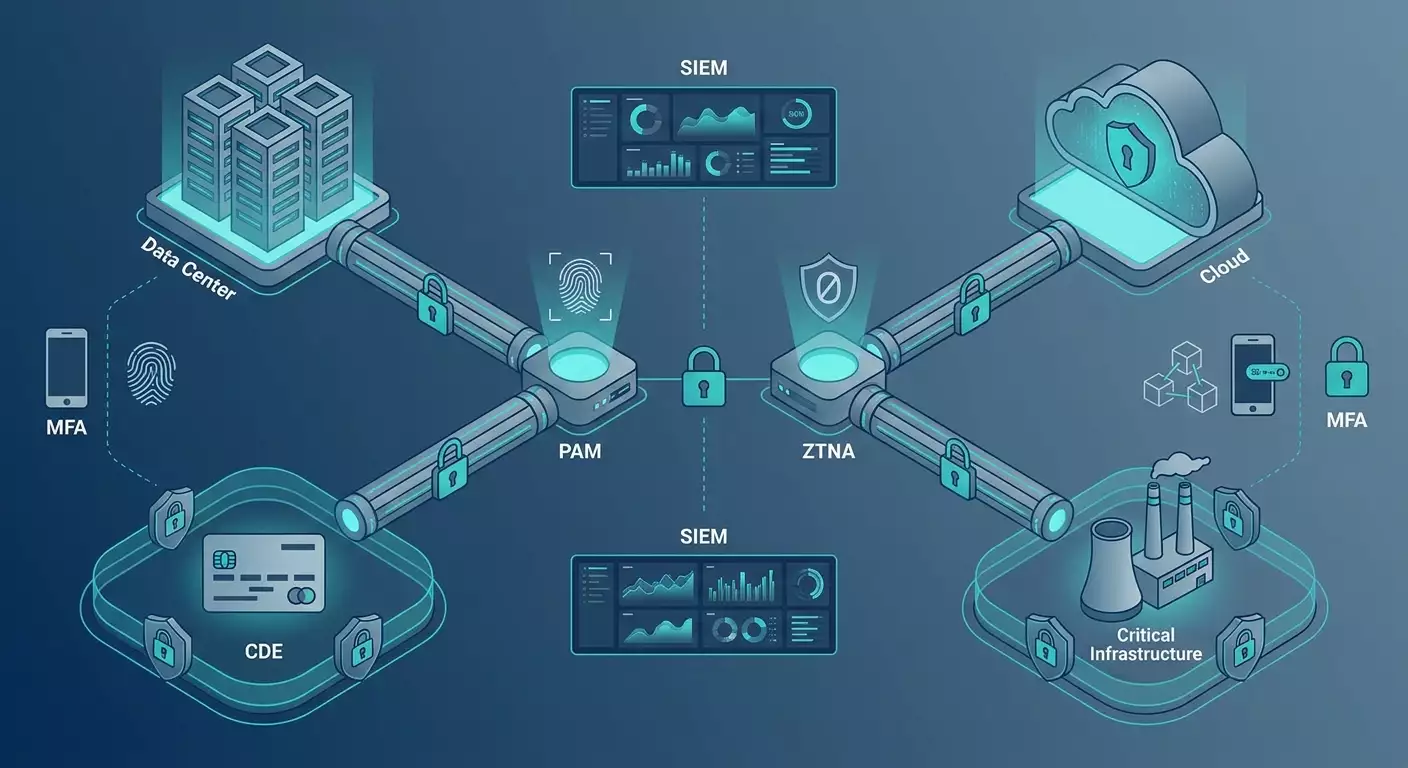
Components: two independent remote access VPN gateways (active-active), clusters of IPsec gateways for site-to-site, DMZ for terminal services and portals, a separate perimeter for vendors, PAM bastion, SIEM, NTP, HSM/cryptographic hardware for keys, ZTNA broker for fine-grained app publishing.
Routing principles: for CDE and CII — only strictly necessary subnets, static or BGP with prefix lists, deny-by-default. User access is full-tunnel when working with critical systems; split-tunnel is permitted for non-essential services outside CDE/CII if host controls and network monitoring are in place.
Step-by-step deployment plan
- Classify assets: CDE, core banking systems, interbank channels, CII perimeter, IT admin, development, office network.
- Map flows: origins and destinations, protocols, traffic volume, required SLA, RTO/RPO.
- Select perimeters: distinct VRF/VLAN/segments for remote users, vendors, admins, applications, and data.
- Define crypto profiles: GOST profile for CII and inter-site links within the CII perimeter; modern international profile (IKEv2/TLS 1.3/WireGuard) for others.
- Enforce vendor access through a dedicated perimeter: mandatory PAM, just-in-time (JIT) access, session logging, no direct access to CDE/CII without an intermediary layer.
- Embed segmentation into routing: prefix lists, ACLs, firewall policies, reverse route checks, no route leaks.
- Implement SIEM and centralized log collection: authentication, tunnel up/down, authorizations, admin commands, PAM events.
- Test resilience: scheduled failovers, simulated link failures, session persistence verification.
Readiness checklist
- Network and flow diagrams with color-coded CDE/CII/common segments.
- Documented routing and filtering policies, with deny examples and exceptions.
- Separate perimeter and VLAN/VRF for vendors. PAM mandatory.
- Channel quality monitoring (jitter/latency/loss KPIs) and alerts enabled.
- Disaster recovery scenarios and scheduled failover tests at least quarterly.
Practice 2: Protocols and Cryptography (Selection, Configuration, Rotation)
Protocol choice by use case
- Site-to-site: IKEv2/IPsec with AES-256-GCM, ECDHE (groups 19/20/21), PFS, lifetimes 8-24h, DPD. For CII — GOST profiles and certified gateways.
- Remote access: IKEv2/IPsec (stable, native clients), TLS 1.3 VPN or WireGuard (high performance, simple key model). In environments with strict DPI — TLS VPN with traffic obfuscation.
- Clientless: TLS 1.3, strong cipher suites, strict isolation of web proxies from internal addresses.
Recommended parameters
- TLS 1.3, no weak ciphers or renegotiation; if TLS 1.2 is necessary — only with AEAD (AES-GCM/CHACHA20-POLY1305), ECDHE, no TLS 1.0/1.1.
- IPsec: IKEv2, AES-256-GCM, PRF SHA-256/384, DH ECP256/384 (grp19/20), PFS enabled, rekey before SA expiration, NAT-T.
- WireGuard: Curve25519 keys, minimal allowed subnets, forced routing to necessary prefixes, key rotation.
- GOST: GOST R 34.10-2012 for signatures, GOST R 34.11-2012 for hashes, GOST R 34.12-2015 (Kuznechik) for encryption — implement in CII perimeters and where mandated.
Keys and certificates
- Establish PKI with role separation: offline root, intermediate issuer, HSM/crypto modules for gateway key storage.
- Use short-lived certificates (90 days) and automation (ACME analogues in closed circuits), OCSP stapling, and CRL.
- MFA: FIDO2/WebAuthn, OTP with replay protection, device binding and posture checking (EDR, disk encryption, updates).
- Rotation: tunnel keys regularly (scheduled), credentials upon incidents and personnel changes.
Cryptographic readiness checklist
- Approved list of protocols and cipher suites by the security committee.
- Unified certificate registry and expiration tracking with alerts at 30/15/7 days.
- Immediate key revocation/replacement procedures with revocation list propagation checks.
- Document mapping protocols to CII/PCI/Central Bank requirements.
Practice 3: Identity Management, MFA, and Vendor Access
Identification and directory
Single source of truth — corporate directory (AD/LDAP) and IdP (OIDC/SAML). Synchronize access groups with RBAC policies on VPN gateways. Admins have dedicated privileged accounts; developers are tied to project groups with expiration dates.
MFA and context
- MFA is mandatory for all remote administrative access, CDE and CII, and for vendors.
- Factors: preferably FIDO2, OTP, push approval. Consider geolocation and device health.
- Apply CAP (continuous access policy): automatically reduce privileges if device posture worsens.
Vendors and JIT access
- Move vendor access into a dedicated perimeter with PAM. No direct VPN to CDE/CII.
- Enable JIT: access granted for specific time windows, with pre-approval and tickets.
- Unique accounts only; no shared logins; sessions recorded and indexed.
- Integration inventory: list vendors, contacts, target systems, MTTD/MTTR for incidents.
Access management checklist
- Role directory and mapping to IdP groups.
- MFA enabled for all remote admins, vendors, and CDE/CII users.
- Automated Joiner/Mover/Leaver processes (SCIM), detection of stale access rights.
- PAM with JIT and session recording deployed; audit-ready reports available.
Practice 4: Logging, Monitoring, Testing, and Auditing
What to log
- Authentication and authorization attempts (successes/failures), MFA factors.
- Tunnel establishment/termination, SA parameters, client addresses, routes.
- Administrative configuration and policy changes.
- PAM and privileged session events, commands, and screen captures.
- Network metrics: NetFlow/IPFIX, TLS/JA3 fingerprints to detect anomalies.
How to store logs
- Unified time (NTP), immutable storage (WORM/S3-object lock), access segregation.
- Retention periods aligned with Central Bank, CII, and PCI requirements, with margin and cost-efficiency.
- SIEM behavioral detectors and signatures, alerts forwarded to SOC on duty.
Testing
- Quarterly resilience and throughput assessments.
- Regular vulnerability scans and VPN gateway updates, zero-day vulnerability monitoring.
- Tabletop exercises and Red Team scenarios focused on remote access perimeter.
- Compliance checks: log reviews, access list reconciliation, vendor session sampling.
Audit checklist
- Current and signed VPN and segmentation policies.
- Complete log billing for the period, with integrity verification.
- Proof of MFA setups and PAM reports.
- Disaster recovery test protocols and outcomes.
- Tunnel and cipher registry with justification of choices.
Practice 5: Performance, Resilience, and Operations
High availability
- Two independent VPN gateways and two ISPs, active-active or active-passive with fast failover.
- Horizontal scaling for remote access: load balancers, session affinity, CPU/crypto redundancy.
- MTU/MSS control, QoS for critical apps, strictly controlled tunnel fragmentation.
Observability
- SLOs: tunnel availability, authentication time, average/peak throughput, packet errors.
- User experience metrics: time to access key applications, MFA success rate per attempt.
- Business metrics: access issuance time, average JIT window, incident investigation time.
Operations
- Strict change freeze before peak loads (payroll days, reporting periods).
- Blue/Green deployments with quick rollback options.
- Standard change catalog and Change Advisory Board for complex operations.
Practice 6: Clouds, Multi-Region, and Cross-Border Considerations
Financial organizations use hybrid setups: private data centers, local clouds, and overseas environments for R&D and analytics. Jurisdiction and cross-border data transfer issues are critical.
- Separate perimeters: production services and client data localized; R&D and non-specific workloads isolated both network-wise and cryptographically.
- Cloud VPN: use IPsec/BGP to cloud gateways, verify SLAs, audits, and cipher compatibility. Enforce route policy control and blackhole testing.
- Cross-border: define what traffic may leave jurisdiction, establish policies and technical restrictions (policy-based routing, DLP).
Cloud integration checklist
- L3/L7 routing diagrams between on-premises and clouds.
- Ciphers and protocols agreed with security and compliance teams.
- Vendor cloud access only via PAM and ZTNA proxies.
- Logs from cloud gateways integrated into unified SIEM with synchronized timestamps.
Practice 7: Transitioning to Zero Trust and Minimizing Tunnels
ZTNA is an evolution: instead of "network as trust," it enforces explicit access to individual applications. For banks and PCI environments, this reduces the attack surface but requires mature processes.
- Catalog applications and define "access surfaces": URLs, ports, protocols.
- Deploy access brokers (ZTNA), integrate with IdP and EDR, activate device posture checks.
- Shift typical VPN app access (Jira, Git, read-only DBs) to ZTNA, keeping VPN for L3 admin traffic and inter-site links.
- Revise policies: only minimal necessary permissions, short-lived credentials, no lateral movement allowed.
Outcome: fewer persistent tunnels, easier segmentation proof, reduced leak risk if accounts are compromised.
Common Mistakes: What NOT to Do in 2026
- Using one broad VPN profile for everyone: breaks least privilege principles and complicates PCI/Central Bank/CII compliance.
- Allowing split-tunnel for CDE/CII without explicit blocking of other traffic: risks data leaks and lateral movement.
- Using weak ciphers and outdated protocols (TLS 1.0/1.1, IKEv1) "for compatibility" without migration plans.
- Shared accounts and no MFA for vendors.
- No session recording for admins and vendors — too late once an incident is investigated.
- Unsynchronized time and ephemeral logs — auditors won’t get a consistent picture.
- No failover tests — issues will surface on payday.
- Ignoring IPv6: tunnels and filters set only for IPv4.
- Relying blindly on cloud provider "as-is" without verifying ciphers and logging.
Tools and Resources: What to Use
Hardware and software solutions
- Enterprise gateways: solutions from major vendors with hardware crypto acceleration, load balancing, and comprehensive access policies.
- GOST-compatible and certified solutions for CII environments.
- Open-source and software stacks: strongSwan/Libreswan (IPsec), OpenVPN, WireGuard, SoftEther — great for flexibility and labs but require operational discipline.
- ZTNA and access brokers: for application publishing with device posture verification.
- PAM: privilege control, session recording, JIT.
- SIEM/SOAR: log collection and correlation, automated response.
- Observability: NetFlow/IPFIX collectors, NTA/NDR, metrics systems, and SLO dashboards.
Practical utilities
- TLS and cipher analysis: compatibility and strength testing.
- IPsec/IKE diagnostics: profile checks, DPD, rekey events.
- Packet analysis and performance profiling.
- Route and ACL inventory, blackhole and loop detection.
Quick start for pilots
For pilots and proofs-of-concept, when you need to validate architectural hypotheses in 1-2 days, it can be practical to use a personal VPN-as-a-service with managed parameters. One viable option is vpn.how: dedicated personal VPN servers (not shared) with unique client IPs, supporting WireGuard, OpenVPN, IKEv2, L2TP, SSTP protocols — you select based on access scenario and compatibility. Server locations include Moscow, Saint Petersburg, Amsterdam, Frankfurt, London, New York, San Jose, Chicago, Singapore, Sydney, Madrid, Helsinki, Stockholm, Warsaw, Copenhagen, Stavanger — ideal for modeling realistic latency and traffic paths. Payment is convenient for Russian legal entities and teams: Russian cards (including Tinkoff, Ozon), SBP, and USDT/BTC accepted. Pricing starts at 490 RUB/day or 2490 RUB/month with discounts for longer terms. Plus, servers auto-start within 5 minutes after payment with no logging. Expert tip: ideal for pilots and short stands to verify crypto profiles, routing, and client compatibility without lengthy procurement; for production and especially CII and payment perimeters, build your own infrastructure with certified gateways and GOST-VPN, including full key management automation, logging, and audit processes.
Cases and Results: How It Works in Practice
Case 1: Universal Bank, Remote Access Migration
Challenge: replace legacy SSL VPN, meet PCI DSS 4.0 requirements, and strengthen vendor control. Solution: two-node remote access architecture (IKEv2/TLS 1.3), vendor segment via PAM and JIT, SIEM session correlation, resilient channels. Results in 6 months: 58% drop in remote access incidents, 42% fewer connection tickets, average access issuance time reduced from 2 days to 3 hours, successful PCI compliance audit with zero encryption and MFA findings.
Case 2: Payment Company with CII Category 2
Challenge: secure inter-site links and admin access in CII perimeter using GOST without slowing R&D. Solution: dedicated CII perimeter with certified GOST IPsec, separate R&D profile (WireGuard) outside CII, PAM with session recording, strict route segmentation, immutable object log storage. Results: passed security audit with no critical remarks, 35% faster incident investigation, predictable inter-site channel performance at 99.95% SLO.
Case 3: Fintech with Multi-Region Analytics
Challenge: secure analyst access to data and models in Europe and the USA without compromising data localization. Solution: hybrid architecture — local data and models under compliance, remote access via TLS 1.3 with device posture, partial app publishing via ZTNA, egress control and DLP for outbound traffic, route and app-level observability. Results: access latency ~120-150ms RTT for key locations, no data leaks found in quarterly checks, 99.9% availability.
Case 4: Vendor Access Refactoring
Challenge: remove persistent vendor accounts from production networks. Solution: JIT access via PAM, client VPN restricted to single app or subnet, mandatory session recording, automatic privilege revocation after ticket closure. Results: 95% reduction in orphaned access, zero access violations per quarter, vendor onboarding accelerated from 3 weeks to 4 days.
FAQ: Common Complex Questions
1. Is WireGuard acceptable for banks and PCI DSS 4.0?
Yes, when policies, MFA, and segmentation are properly implemented. PCI demands "strong cryptography" and manageability, not specific protocols. For CII, GOST profiles may be required — use certified solutions in parallel there.
2. Must I disable split-tunnel?
By default, avoid split-tunnel in CDE and CII. If used, document risks, enforce routing only for corporate prefixes, control device posture, and enable network monitoring.
3. Does ZTNA replace VPN?
Not entirely. VPN is still needed for L3 admin traffic, inter-site links, and some protocols. ZTNA significantly reduces attack surface for typical user applications.
4. How to handle GOST and foreign sites?
Use a dual-profile crypto model: GOST within CII/local perimeters, international profiles outside CII and abroad. Maintain strict segmentation and route control between them.
5. Can I use cloud-managed VPN gateways?
Yes, if you control ciphers, logging, and comply with localization and cross-border rules. Always integrate logs into your SIEM.
6. How to prove segmentation correctness to auditors?
Provide diagrams, routing/ACL policies, selective path traces, PAM reports, and connection logs. Automated policy checks and route snapshots are good practices.
7. What about IPv6?
Enable IPv6 support alongside IPv4: filters, routing, monitoring. Otherwise, "blind spots" will emerge, enabling control bypass.
8. How often to update crypto profiles?
Quarterly reviews, annual revisions, and immediate updates upon critical vulnerabilities or new requirements.
9. Is MFA mandatory for everyone?
Mandatory for admins, vendors, and CDE/CII access. For others, risk-based, but best to enable universally.
10. How to integrate SOC and VPN operations?
Unified log and metric repositories, combined SLO/SLA dashboards, end-to-end SOAR playbooks, and regular joint exercises.
Conclusion: How to Move Forward
The VPN perimeter for banks and financial organizations in 2026 is not just about "clicking encrypt." It’s about architecture, manageability, and demonstrable security. Key steps:
- Threat assessment and modeling: asset inventory, CDE/CII segmentation, traffic mapping.
- Architectural blueprint: protocol choice (dual-profile GOST/international), DMZs, vendor perimeter, PAM, and ZTNA.
- Pilot and measurements: verify throughput, resilience, MFA, and logging operations.
- Production rollout: HA, PKI automation, centralized logging, JML/JIT processes, SOC integration.
- Audit readiness: policies, reports, DR scenarios, regular tests, continuous improvements.
If you need a quick POC, use fast-start services to validate hypotheses, latency, and client compatibility. But for production and especially CII and payment perimeters, rely on your own managed infrastructure, certified solutions, and mature processes. Bottom line: a properly designed and observable VPN not only meets Central Bank of Russia, PCI DSS 4.0, and CII requirements but also accelerates business by delivering access quickly, securely, and predictably.
Publisher: vpn.how